

To fully unlock its potential, Binh Phuoc province critically needs high-tech, closed-loop agricultural models that span from production to consumption. An exemplary model for this is that of Hung Nhon Group, a pioneer in modern cultivation and livestock farming in Vietnam.
Hung Nhon Group's integrated approach, covering everything from breeding stock and feed to farming and processing, serves as a blueprint for the province's agricultural development. By adopting such comprehensive and technologically advanced models, Binh Phuoc can significantly enhance productivity, ensure product quality, and secure stable market access, thereby maximizing its inherent agricultural advantages.
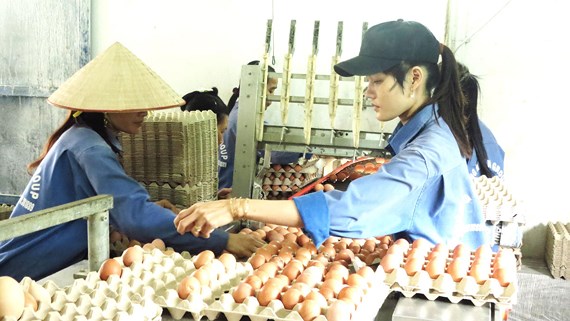
Hung Nhon Group: Pioneering High-Tech, Sustainable Livestock Farming in Vietnam
BINH PHUOC – Hung Nhon Group is making significant strides in modernizing Vietnam's agricultural sector through advanced technology and strategic partnerships. A recent visit to their facilities in Binh Phuoc revealed the quiet efficiency of their operations, driven by cutting-edge "cold-house" farming technology that minimizes the need for extensive manual labor.
Cold-House Chicken Farming: A Model of Efficiency
At their chicken farm in Thuan Loi commune, Dong Phu district, the first impression is one of tranquility, with minimal human activity. This is because the entire process, from feeding and watering to egg collection and waste removal, is fully automated. On a 7-hectare site, eight chicken houses each accommodate over 41,000 birds. Feed is automatically delivered from an external boiler, and eggs are gently transported by conveyor belts. Just one worker is needed to oversee an entire house.
Outside the houses, workers simply collect, sort, clean, and disinfect the eggs before packaging. The packaging process is also automated. Chicken manure is efficiently moved by conveyor to the back of the farm for transport to a nearby processing plant. The farm boasts an impressive daily output of nearly 315,000 eggs, totaling 130 million eggs annually, with guaranteed sales through a partnership with CP Vietnam Livestock Joint Stock Company.
Approximately 8 km away, the Thuy Thao broiler farm, spanning 20 hectares, features 20 cold-house chicken farms. These also employ advanced technology from Germany's Big Dutchman Group, ensuring 100% automation throughout the raising process. This facility produces a remarkable 3 million broiler chickens per year.
To realize these two large-scale chicken farming projects, Hung Nhon Group has forged a strong, sustainable partnership with:
- De Heus (Netherlands): Supplying high-quality animal feed.
- Bel Ga (Belgium): Providing breeding chickens for the Vietnamese market.
- San Ha Co., Ltd.: Supplying commercial broiler chickens to domestic supermarkets.
The total investment for these two egg-laying and broiler chicken farms exceeds 180 billion VND. Hung Nhon Group plans to invest in an additional 10 broiler farms, aiming to increase their market supply to 4 million broiler chickens annually. Beyond meat and eggs, the two farms also produce approximately 20,000 tons of chicken manure per year, which is processed into fertilizer for the group's rubber plantations and supplied to local farmers.
Expanding Horizons: High-Yield Pig Breeding in Dak Lak
Building on the success of their Binh Phuoc chicken farms, Hung Nhon Group and De Heus (Netherlands) formalized a joint venture agreement on April 10 in Hanoi, witnessed by representatives from the Vietnamese and Dutch governments. This partnership established DHN Dak Lak High-Yield Pig Breeding Development Joint Stock Company.
Recognizing the critical need for disease-free pig farming zones and the high demand for healthy, high-yielding breeding stock following recent disease outbreaks, both groups are accelerating their collaboration to build a modern pig farming system in Dak Lak province.
This project will directly import selected great-grandparent (GGP) and grandparent (GP) pigs from the Netherlands to produce high-quality GP and parent-stock (PS) pigs. This ensures a superior genetic pool for high reproductive performance, supplying Vietnamese farmers with much-needed breeding stock.
The pig farming process will be fully automated using Industry 4.0 technology, from De Heus's feed production facilities to individual pigs fitted with microchips. Management software will enable DHN Dak Lak High-Yield Pig Breeding Development Joint Stock Company to precisely monitor farm conditions, animal health, feed rations, growth periods, and reproductive cycles for each animal. This software also aids in managing input and output costs to calculate breeding efficiency and, importantly, provides early warnings for potential issues, allowing De Heus's technical team to analyze and implement timely solutions.
The project is designed with a breeding capacity of 2,400 GGP and GP pigs, implemented in four phases, with a total investment of approximately $22 million (equivalent to 500 billion VND). Once operational, it will annually supply approximately 22,000 GP and PS pigs to the market.
A significant innovation in the Dak Lak pig breeding project is the solar power system installed for the farms. This marks it as the first livestock farm model in Vietnam to incorporate a solar power system from its inception for production purposes, offering long-term benefits. Utilizing renewable solar energy not only helps protect the environment but also provides a more cost-effective power source compared to traditional electricity. This initiative underscores De Heus's commitment to supplying clean and sustainable products, from animal feed to high-quality breeding stock.
VĂN PHONG


