

At precisely 9:09 AM on September 9, 2017, at Long An International Port (Can Giuoc District, Long An Province), the first 400 tons of Vietnamese broiler chicken were officially exported to Japan. This remarkable achievement bears the strong mark of Hung Nhon Group.
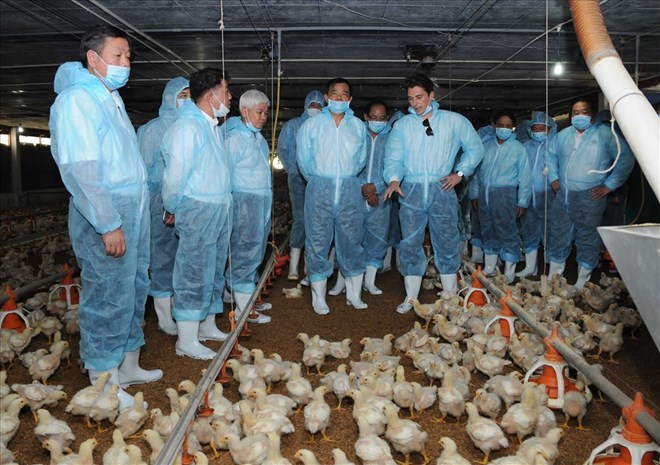
In the landmark export of 400 tons of chicken to Japan, Hung Nhon Group (Binh Phuoc province) played a pivotal role as Vietnam's leading poultry farmer. They successfully raised millions of broiler chickens to GlobalGAP standards, overcoming the most stringent control hurdles to enable Vietnamese chicken to enter the Japanese market.
This successful export was a collaborative effort involving several key enterprises:
- De Heus Co., Ltd. (part of De Heus Group – Netherlands) supplied feed.
- Bel Gà Joint Stock Company (Belgium) provided the breeding stock.
- Hung Nhon Group (Binh Phuoc) was responsible for raising the chickens in GlobalGAP-certified farms.
- Koyu & Unitek Co., Ltd. (Dong Nai) handled procurement, slaughtering, and export to Japan.
This integrated chain formed a closed loop, producing clean chicken meat that met Japan's extremely strict quality standards.
Mr. Vu Manh Hung, Chairman of Hung Nhon Group, stated, "Exporting food to Japan fundamentally requires the food to be clean and pure. Therefore, to fulfill our dream of exporting chicken meat to the Japanese market, we mandated that every member of the value chain adhere to all the strictest regulations set forth by Japan."
He added, "Hung Nhon Group specifically took on the responsibility of raising the chickens, which was the most challenging and arduous task. This is because raising chickens isn't a matter of days; it extends for 45 days. From tiny chicks to market-ready chickens weighing over 2 kg/bird, it's a long journey that requires maintaining the chickens in the healthiest and cleanest condition, strictly adhering to international standards for feed, environment, and more." Indeed, Hung Nhon Group is recognized as a livestock farmer with Vietnam's most modern farm system.
With nearly 40 farms located in Dong Phu district, Binh Phuoc province, Hung Nhon Group has ample capacity to supply hundreds of tons of clean meat to both domestic and export markets each month. Notably, for its chicken farms, Hung Nhon Group invested millions of USD in highly modern equipment from Big Dutchman Group (Germany), creating an automated, closed-loop cold chicken housing system.
Mr. Nguyen Van Minh, Head of Administration and Human Resources at Hung Nhon Group, stated, "To achieve this export batch of chickens that met Japanese standards, beyond Hung Nhon Group's investment of tens of millions of USD in farm infrastructure and modern equipment..."

Hung Nhon Group's success in exporting chicken to Japan hinges on a steadfast commitment to stringent standards and a pioneering spirit in management and technology.
Uncompromising Standards for "Clean" Chicken
Mr. Vu Manh Hung, Chairman of Hung Nhon Group, emphasized that to meet Japan's demanding import requirements, their operations go far beyond basic high-tech farming. "We had to build a professional and scientific management system, capable of monitoring the health of millions of chickens daily," he stated. "Beyond that, we needed to create a truly airy environment with sufficient light for the flock's development. Of course, breeding stock must meet standards, veterinary checks must be periodic, and feed must also be within permissible standards; chickens cannot be fed just anything. Only then can we produce truly 'clean' chickens, suitable for export to Japan."
A critical demand from Japanese partners was the absolute prohibition of antibiotics. "If any finding is 'positive' for antibiotics, the entire shipment will not be allowed into Japan," Mr. Hung stressed. Consequently, Hung Nhon Group's entire process for raising chickens for export is completely free of harmful antibiotics.
Furthermore, Japanese importers have specific humane requirements, prohibiting the handling of poultry by the head, neck, wings, and tail, reflecting a commitment to animal welfare. During the rearing process, influenza prevention drugs are strictly forbidden. The farming areas must be officially declared disease-free zones by the state. Before chickens enter the processing plant, veterinary forces must inspect each bird, and no antibiotics whatsoever can be used on poultry within 10 days prior to slaughter.
Digital Transformation and Traceability
Beyond training a skilled workforce capable of raising GlobalGAP-certified flocks, Hung Nhon Group has also pioneered the implementation of a "Farm Management and Traceability" software, provided by Perpetual Technology Solutions JSC (PERP JSC). According to Mr. Nguyen Van Minh, this software digitizes all farming operations, enabling comprehensive monitoring of farm activities according to GlobalGAP standards.
"For instance, chicken feed must be traceable back to the supplier and its storage conditions recorded," Mr. Minh explained. "Drinking water for poultry is managed through the software, ensuring it is clean, potable, and free from any hazards to poultry health or the safety of their meat and eggs. The water quality for poultry must meet human drinking water standards, with annual analysis records at a minimum."
Similarly, the feed supplied for the chickens exported to Japan is provided by De Heus Group (Netherlands). Mr. Gabor Fluit, General Director of De Heus Co., Ltd. (Binh Duong), confirmed: "All feed produced by De Heus contains no prohibited substances and adheres strictly to GlobalGAP standards. The feed originates from sustainable sources, is independently certified, and its origin is fully traceable. For many years, De Heus and Hung Nhon Group have collaborated exceptionally well in the livestock sector. Therefore, with the determination to export chicken to Japan, De Heus will be an active partner assisting Hung Nhon Group."
A New Era for Vietnamese Agriculture
Mr. Vu Van Tam, Deputy Minister of Agriculture and Rural Development, emphasized that "Vietnam is an open market. Therefore, even for domestic meat consumption, products must meet export standards. This means products must comply with technical barriers, food safety standards, and be competitive."
He hailed Hung Nhon Group's pioneering effort in raising and exporting the first batch of chicken meat to the Japanese market as a "very significant first shot" for Vietnam in exporting chicken abroad. "In the future, not just chicken, but also pork and other agricultural products must strive to meet standards and seek export markets," Mr. Tam stated. "This will greatly help farms and farmers sell their produce, escaping the cycle of one 'rescue' after another, which lacks sustainability and fundamental solutions."
Ban Truyền Thông.


