

At this Forum, Mr. Vu Manh Hung, who serves as Vice Chairman of the Vietnam Digital Agriculture Association (VIDA), Head of the EuroCham Agriculture Sub-committee's Connectivity Working Group, and Chairman of Hung Nhon Group, represented agricultural businesses. He shared insights into the current state of agriculture and his investment experience in the sector, with a particular focus on applying high technology to livestock farming models that meet international standards.
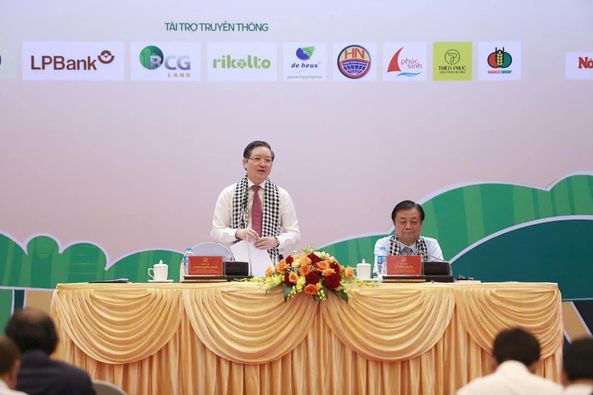
Hung Nhon Group: Navigating Challenges and Embracing Transformation in Vietnamese Agriculture
Mr. Vu Manh Hung of Hung Nhon Group recently shared his candid assessment of the current state of Vietnamese agriculture and his company's response to its challenges.
According to Mr. Hung, Vietnam's agricultural sector largely remains extensive and managed on a small-scale farming model. This leads to high risks and low efficiency, with the added value of agricultural commodities being particularly low. He highlighted that agro-processing and deep-processing industries are underdeveloped, often characterized by small scales and outdated technology. Furthermore, many policies designed to attract investment into agriculture have not proven effective.
Mr. Hung frankly stated, "For businesses operating in agriculture, the difficulties aren't just limited to the issues I've just presented. 2024, in particular, can be described as an unforgettable moment as we are witnessing unprecedented challenges. From abnormal weather phenomena and global geopolitical tensions to economic recession… All of these are having a very negative impact on the production and business activities of enterprises, especially agricultural enterprises."
Despite these systemic and current challenges, Hung Nhon Group's trajectory, as previously discussed, indicates a proactive shift towards high-tech, closed-loop models to overcome these very obstacles.
"After the failure of our small-scale farming model, we decided to partner with top 10 global agricultural corporations like De Heus (Netherlands) and Belga (Belgium)," said Mr. Hung. "Through this collaboration, Hung Nhon quickly established itself as one of the leading agricultural groups, achieving a series of international GlobalG.A.P. certifications comprising 349 stringent criteria."
Mr. Hung proudly shared: "Above all, what makes me happiest is that the joint venture model between De Heus and Hung Nhon (DHN) not only helps Vietnam's agricultural sector embrace a 'new wave' in applying technology for sustainable production and integrating production with consumption, along with high-tech agricultural cooperative models based on Dutch experience; it also serves as a highlight for the friendly relations between Vietnam and the Netherlands. In 2022, when we signed the memorandum of understanding for investment cooperation in the Netherlands, it was witnessed by both Prime Minister Pham Minh Chinh of Vietnam and the Prime Minister of the Netherlands."
.jpg)
DHN Drives Green Transformation with Major High-Tech Livestock Investments
DHN (the joint venture between De Heus and Hung Nhon Group) is making significant strides in sustainable, high-tech livestock farming.
Currently, Phase 1 of their 200 billion VND high-tech livestock breeding complex is complete and has been operational since Q2. Looking ahead, Phase 2 (2025-2030) is set to see DHN invest simultaneously in six new high-tech livestock projects, with a colossal total investment exceeding 3,200 billion VND.
A standout feature of DHN's projects is their commitment to sustainable technology. As Mr. Hung proudly states, "DHN's projects all apply modern technology and closed-loop processes according to international ISO and GlobalG.A.P. standards. Crucially, all projects utilize a grid-connected solar power system, using 30% clean electricity, significantly reducing CO2 emissions compared to traditional power sources." This represents a major step towards green transformation within the agricultural sector.
This trend is particularly vital for livestock farming, as it demands synchronized efforts across the entire model, from breeding stock and feed production to actual farming, processing, and food supply.
Mr. Hung also acknowledged the hurdles faced: "Although we encountered several challenges related to land clearance and compensation, especially in adapting to the new regulations of the 2024 Land Law, which takes effect on August 1st. These are major changes that require us to enhance our leadership capabilities and improve our information systems to manage and monitor projects accurately and promptly."
Phòng Truyền thông.

Hung Nhon: Controlling the Entire Value Chain to Access International Markets
“A good product alone is not enough to enter highly demanding markets. Behind the product must be an integrated production chain with consistent control, from breeding stock, animal feed, farms and biosecurity to processing, traceability and environmental standards.”

HUNG NHON NEWS – ISSUE 06 (AUGUST 2026)
HUNG NHON NEWS – ISSUE 06 (AUGUST 2026)

Hung Nhon - De Heus Strengthen Connections for Dutch Investment in Tay Ninh
Hung Nhon - De Heus Strengthen Connections for Dutch Investment in Tay Ninh

Hung Nhon – De Heus Commit VND 18.3 Trillion to Expand the High-Tech Agricultural Value Chain in Tay Ninh
Tay Ninh, August 28, 2026 – As part of the Tay Ninh 2026 Investment Promotion Conference, the Tay Ninh Provincial People’s Committee held a ceremony to acknowledge the investment interest of 41 corporations in 59 projects, with total proposed investment capital of approximately VND 720 trillion, equivalent to US$28 billion.

Hung Nhon Presents Gifts to Families Affected by Agent Orange/Dioxin and Disadvantaged Students in Tay Ninh
Tay Ninh, August 27 – Hung Nhon Group presented 100 gift packages, with a total value of VND 75 million, to families affected by Agent Orange/Dioxin and students facing difficult circumstances in Tan Hoi Commune, Tay Ninh Province.

Hung Nhon participates in policy dialogue at the Vietnam Private Sector Economic Forum 2026 in Dong Nai City
Hung Nhon participates in policy dialogue at the Vietnam Private Sector Economic Forum 2026 in Dong Nai City

HUNG NHON NEWS – ISSUE 05 (JULY 2026)
HUNG NHON NEWS – ISSUE 05 (JULY 2026)

De Heus – Hung Nhon propose expanding the high-tech agricultural value chain in Dak Lak
De Heus – Hung Nhon propose expanding the high-tech agricultural value chain in Dak Lak

Hung Nhon joins Tay Ninh provincial leaders in visiting and honoring families of national contributors in Tay Ninh Province
Hung Nhon joins Tay Ninh provincial leaders in visiting and honoring families of national contributors in Tay Ninh Province

Hung Nhon pays tribute to the heroic martyrs of Regiment 207, Military Region 8
Hung Nhon pays tribute to the heroic martyrs of Regiment 207, Military Region 8

Hung Nhon joins Tay Ninh provincial leaders in supporting families of national contributors and disadvantaged students
Hung Nhon joins Tay Ninh provincial leaders in supporting families of national contributors and disadvantaged students

Hung Nhon pays a respectful visit to Vietnamese Heroic Mother Lam Thi Ranh in Binh Hoa Commune, Tay Ninh Province
Hung Nhon pays a respectful visit to Vietnamese Heroic Mother Lam Thi Ranh in Binh Hoa Commune, Tay Ninh Province


